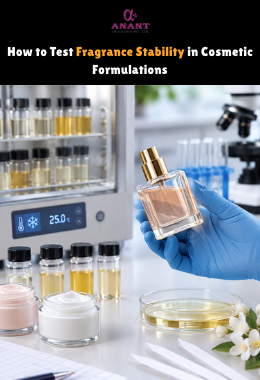
Fragrance stability testing checks whether a fragrance keeps its scent, colour and performance inside a finished cosmetic. You store samples under set conditions and compare them with a fresh control. Any change in smell, colour or texture means the fragrance has failed.
This guide explains fragrance stability testing in cosmetics step by step. It also covers fragrance compatibility testing, common mistakes and fixes.
What Is Fragrance Stability Testing?
Fragrance stability testing is a storage study that shows how a fragrance behaves in a finished product over time. Teams run it on the final formula and the final pack, and compare each aged sample with a control.
Fragrance stability in cosmetics depends on the base as much as the fragrance oil. A fragrance can stay perfect in the concentrate and still fail in a lotion or soap.
Here is how the two stages differ:
- Fragrance concentrate: the aroma blend before it meets the product base.
- Finished formulation: the full product, with water, surfactants, emulsifiers, preservatives and packaging.
Cosmetic formulation stability testing looks at the whole product. Fragrance formulation testing looks at the scent part of that product. Fragrance stability testing in cosmetics works best when both studies run side by side.
To ensure long-lasting scent and consistent product quality, explore Anant Fragrance’s range of cosmetic fragrances designed for beauty and personal care formulations.
Why Does Fragrance Stability Testing Matter in Cosmetics?
Fragrance stability testing in cosmetics matters because customers judge a product by its smell first. A weak scent, a yellow tint or a sour note leads to complaints and returns.
A product may sit in a warehouse at 38°C for weeks. Indian summers, monsoon humidity and long export routes all raise this risk.
Cosmetic fragrance stability also affects retailer trust. A buyer who sees colour change on a shelf rarely reorders.
Fragrance stability testing before launch gives you three gains. First, you catch scent drift while the formula is still easy to change. Second, you keep batches consistent. Third, you build a record that supports your shelf-life claim. Strong cosmetic fragrance stability keeps customers loyal.
Which Factors Change Fragrance Stability Testing Results?
Five factors change fragrance stability testing results the most: heat, light, pH, oxygen and fragrance dosage. Ingredient interactions sit behind all five and shape cosmetic fragrance stability.
- Temperature: Heat harms fragrance stability in cosmetics. Top notes fade first.
- Light: UV rays cause yellowing, especially in clear bottles.
- pH: Alkaline bases, such as soap, react with aldehydes and vanillin.
- Oxygen: Air lowers fragrance stability in cosmetics by oxidising citrus notes.
- Dosage: Most rinse-off products use about 0.3 to 1.0 percent fragrance. A higher dose raises the risk of haze and fragrance discoloration in cosmetics.
Metal ions and amines also lower fragrance stability in cosmetics. For example, vanillin often darkens near amine-based ingredients. This is the main reason behind fragrance discoloration in cosmetics.
Fragrance compatibility testing should also reflect the base type. This table shows what to watch in fragrance testing for cosmetics.
|
Product base |
Typical pH | Main fragrance risk |
|
Surfactant body wash |
5.0 to 6.5 | Haze, scent loss |
| Soap bar | 9.0 to 10.5 |
Discolouration |
| Cream or lotion | 5.0 to 6.5 |
Oxidation, separation |
How Do You Complete Fragrance Stability Testing Step by Step?
You complete fragrance stability testing in cosmetics in seven steps: prepare samples, set controls, record a baseline, fill packs, store, inspect and judge against set limits. Follow this order for clean fragrance testing for cosmetics.
- Make a pilot batch. Use the same process as production for fragrance formulation testing.
- Prepare three versions. Make one unfragranced control, one sample at the planned dose, and one at a higher dose.
- Record the baseline. Note scent, colour, pH, viscosity and appearance.
- Fill the final pack. Also fill a glass jar. The glass sample shows whether the pack affects fragrance formulation testing results.
- Store under several conditions. Use 4°C, 25°C and 40°C, as in perfume stability testing. Add light and freeze-thaw tests where relevant.
- Inspect at fixed intervals during cosmetic formulation stability testing. Check at 1, 2, 4, 8 and 12 weeks. Continue real-time checks at 6 and 12 months.
- Judge against written limits. Set acceptance criteria for cosmetic formulation stability testing before it starts.
Let each sample return to room temperature for 24 hours before you smell it. Warm samples give false cosmetic fragrance stability readings. Fragrance formulation testing also needs photos at every check.
Which Fragrance Stability Testing Methods Work Best?
No single method suits fragrance testing for cosmetics, so combine accelerated, real-time, freeze-thaw, light and packaging tests. Each fragrance stability testing method reveals a different failure. The table below compares them for cosmetic fragrance stability.
|
Method |
Typical condition | What it shows |
|
Accelerated |
40°C or 45°C, 8 to 12 weeks |
Early colour and scent drift |
|
Real-time |
25°C, full shelf life |
True shelf-life behaviour |
|
Freeze-thaw |
-10°C and 25°C, 3 cycles |
Separation, haze |
| Light exposure | UV cabinet, 2 to 4 weeks |
Fading, yellowing |
| Packaging | Final pack at 40°C |
Absorption, leakage |
Many labs treat 12 weeks at 40°C as a rough guide to one year at room temperature. However, this is only a guide. Therefore, always confirm with real-time data.
The same logic applies to perfume stability testing. Perfume stability testing for alcohol-based sprays needs light and heat checks, while creams need pH and emulsion checks. Perfume stability testing and cosmetic formulation stability testing both need the final pack. Fragrance testing for cosmetics should also match the target market, so test the climate your buyers live in.
Is accelerated fragrance stability testing enough? No. It predicts trouble early, but real-time results give the final proof.
What Are the Signs of Failed Fragrance Stability Testing, and How Do You Fix Them?
The main signs of failed fragrance stability testing in cosmetics are a changed scent, a colour shift, haze, separation and pack damage. Investigate each sign first, because the base or the pack may be the real cause.
Watch for these signs:
- A sour, metallic or flat smell
- Yellow or brown tint
- Cloudiness or fine particles
- Soft, swollen or leaking packs
Fragrance discoloration in cosmetics is the most common complaint. To confirm the cause, test the unfragranced control at the same time. If the control stays clear, the fragrance is the likely cause. Fragrance discoloration in cosmetics often appears first at 40°C.
Here are four fixes that work:
- Swap the problem ingredient for a stable alternative.
- Lower the fragrance dose in small steps.
- Add an antioxidant or chelating agent.
- Switch to opaque or UV-blocking packs.
After any change, repeat fragrance stability testing. Keep every fragrance stability testing result and batch record. Strong fragrance formulation testing records also help during audits, and fragrance compatibility testing data helps your next launch.
Early input on fragrance testing for cosmetics saves time. Anant Fragrance, based in Ahmedabad, Gujarat, has made fragrances since 1985. The team develops scents for body wash, shampoo, soap, deodorant and cosmetics. Its process includes fragrance compatibility testing, durability and performance tests, and it exports to Asia, the Middle East, Africa, Europe and the Americas. Share your base, pH and pack type, and explore the body wash fragrance range.
What Are the Most Common Questions About Fragrance Stability Testing?
1. How long does fragrance stability testing take?
Accelerated checks take 8 to 12 weeks, and perfume stability testing follows a similar schedule. Real-time studies run for the full shelf life.
2. What causes fragrance to change colour?
Vanillin, aldehydes, amines, metal ions, light and high pH cause most fragrance discoloration in cosmetics.
3. Is accelerated stability testing enough?
No. Accelerated cosmetic formulation stability testing gives an early warning, but real-time data confirms the shelf life.
4. Can fragrance affect a cosmetic product’s pH?
Yes, slightly. Measure pH before and after adding fragrance during fragrance compatibility testing.
5. Why should fragrance be tested in the final formulation?
Fragrance stability testing needs the final formula, because the base, pH and pack change fragrance stability in cosmetics.
Follow us on Facebook and Instagram for the latest fragrance trends, seasonal scent tips, and fine fragrance updates.