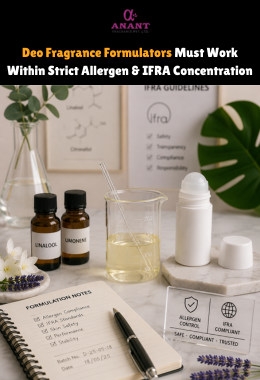
Making a deodorant smell good is not the hard part. The hard part is making it smell good without harming anyone. And that is exactly why deo fragrance formulators do not just pick nice-smelling ingredients and mix them together. There is a whole system of rules, limits, and safety checks they have to follow every single time.
Two of the biggest ones are allergen restrictions and IFRA concentration limits.
Most people have never heard of either. But these two things quietly decide what goes into almost every deodorant, body spray, and roll-on sitting on a store shelf right now.
First, What Do Deo Fragrance Formulators Actually Do
A deo fragrance formulator is someone who creates the scent component of a deodorant product. They select raw fragrance materials -natural extracts, synthetic aroma chemicals -and combine them in specific ratios to build a final scent profile.
Sounds creative. And it is.
But it is also deeply technical. Because the skin under your arms is sensitive. It stays in contact with the product for hours. Sometimes the whole day. So whatever goes into that fragrance had better be safe at that level of exposure.
That is where allergen limits and IFRA guidelines come in.
What Are Fragrance Allergens
Certain chemical compounds found in fragrances -both natural and synthetic -are known to cause allergic reactions in some people. These reactions can range from mild skin irritation to severe contact dermatitis.
The European Union has identified 26 fragrance substances as declared allergens. If any of these are present above a certain concentration in a leave-on product like deodorant, they must be listed on the label.
Some of the commonly known ones include:
- Linalool -found naturally in lavender and many florals
- Limonene -present in citrus-based ingredients
- Eugenol -occurs in clove and some spice notes
- Geraniol -common in rose and geranium extracts
- Citronellol -found in rose and citronella oils
These are not rare or exotic chemicals. They show up in ingredients that deo fragrance formulators use regularly. So managing their concentration is a constant part of the job.
What Is IFRA and Why Does It Matter
IFRA stands for the International Fragrance Association. It is an industry body that sets globally recognized safety standards for fragrance use across different product categories.
IFRA releases guidelines -called IFRA Standards -that specify the maximum allowed concentration of certain fragrance ingredients in different product types. Deodorants and body sprays fall under a specific category, and the limits for that category are stricter than, say, a scented candle or a home diffuser.
The reason is simple. Deodorants are leave-on products applied to skin that is often freshly shaved or slightly broken. The absorption rate is higher. The exposure is longer. So the safety threshold has to be tighter.
Deo fragrance formulators work with these IFRA limits as a non-negotiable boundary. Going above the limit is not a risk any responsible formulator takes.
Why These Limits Make the Job Harder
Working within strict concentration limits is genuinely challenging. Here is why.
Many of the most appealing, long-lasting fragrance materials happen to be on the restricted list. Natural musks, certain florals, some woody base notes -these are the ingredients that give a fragrance depth and staying power. But they also carry a higher sensitization risk.
So deo fragrance formulators have to:
- Build a scent that smells full and developed
- Stay within the allergen concentration limits for each restricted ingredient
- Comply with IFRA Standards for the deodorant product category
- Make sure the fragrance still performs well after mixing with other deodorant base ingredients
- Account for how the scent changes on skin over time
All of that at once. It requires both creativity and precise technical knowledge.
The Risk of Getting It Wrong
If a deo fragrance formulator exceeds allergen limits or violates IFRA guidelines, the consequences are serious.
On the consumer side, people can develop allergic reactions. Repeated exposure to a sensitizing ingredient can cause the immune system to react more aggressively each time. What starts as mild itching can turn into a chronic skin condition.
On the business side, products can be pulled from shelves. Regulatory action can follow. Brand reputation takes a hit that is very hard to recover from.
This is why compliance is not treated as optional in the fragrance industry. Deo fragrance formulators understand that their work sits at the intersection of creativity and responsibility.
How Formulators Stay Compliant
Staying within allergen and IFRA limits requires a proper system, not just good intentions.
Most professional deo fragrance formulators use fragrance management software that tracks the concentration of every ingredient in a formula against IFRA limits in real time. Raw material suppliers also provide safety data sheets that include allergen declarations.
Beyond software, formulators:
- Regularly update their ingredient knowledge as IFRA releases new standards
- Test finished fragrances through dermatological safety assessments
- Work closely with regulatory teams before a product goes to market
- Document every ingredient and its concentration for full traceability
It is detailed work. But it is necessary work.
The Bigger Picture
People expect their deodorant to smell good. They also expect it not to irritate their skin or cause a reaction they did not sign up for.
Deo fragrance formulators carry that responsibility every time they sit down to build a new scent. Allergen limits and IFRA concentration guidelines are not bureaucratic obstacles. They are the framework that makes it possible to create fragrances that are both beautiful and safe.
Working within those limits is not a limitation on creativity. Skilled deo fragrance formulators will tell you it is the opposite. Constraints push you to find better solutions. And in fragrance, better solutions usually smell better too.
Create long-lasting and skin-friendly deodorant products with expertly crafted deo fragrance solutions designed for freshness and performance.
FAQs
Q1. What is the main job of deo fragrance formulators?
They create the scent blend used in deodorant products, making sure it smells good and meets all safety standards.
Q2. Are all fragrance allergens harmful to everyone?
No. They only cause reactions in people who are sensitized to that specific ingredient. But since sensitization can develop over time, limits are set to protect everyone.
Q3. Does IFRA compliance mean a product is completely allergy-proof?
Not exactly. It means the product meets globally recognized safety thresholds. Individual sensitivities can still vary.
Q4. How often do IFRA standards change?
IFRA updates its standards periodically as new safety data becomes available. Formulators stay updated to keep their formulas compliant.
Q5. Can natural ingredients also be restricted under IFRA?
Yes. Many natural extracts contain restricted allergens. Natural does not automatically mean unrestricted or safer in fragrance terms.
Follow us on Facebook and Instagram for more inspiration and product news.