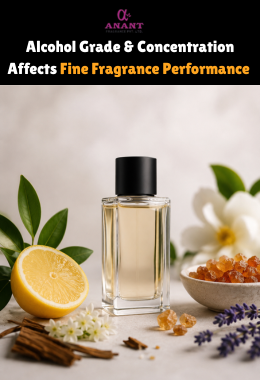
Most people spray perfume and think the scent is everything. The name on the bottle, the oils inside, the fancy bottle cap. What nobody talks about is the thing that makes up 70 to 92 percent of that liquid -alcohol.
Alcohol in perfume is not just a carrier. It is the engine. Get it wrong, and even the most expensive fragrance concentrate in the world will either disappear in an hour or smell off from the first spray. Get it right, and the same formula becomes something that stays with you all day, develops beautifully, and leaves a trail behind you as you walk.
This is what fine fragrance performance is actually built on -and alcohol grade is a bigger part of that story than most people realize.
What Does Alcohol Actually Do in a Perfume?
Before getting into grade and concentration, it helps to understand what alcohol is doing inside the bottle.
Alcohol -specifically ethanol -does three main things in a fragrance:
- It dissolves the fragrance oils completely, creating a stable and uniform liquid
- It evaporates quickly off the skin, which is what pushes the scent molecules into the air around you
- It preserves the formula over time by stopping microbial growth
That middle job is the most important one for fine fragrance performance. When alcohol evaporates, it carries aromatic compounds with it. The speed and cleanliness of that evaporation depend entirely on the grade and concentration of the alcohol used.
Why Alcohol Grade Changes Everything
Not all alcohol is the same. There is food-grade ethanol, cosmetic-grade ethanol, denatured alcohol, isopropyl alcohol, and industrial-grade variants. Each one behaves differently on the skin and in a formula.
The gold standard for fine fragrance is cosmetic-grade ethanol at 95 to 96 percent concentration. This type is:
- Colorless and completely odorless on its own
- Able to dissolve virtually all fragrance materials cleanly
- Fast-evaporating without leaving any residue behind
- Neutral enough not to interfere with the top, heart, or base notes
When a low-grade alcohol is used instead -say, an industrial-grade or an impure batch -impurities inside that alcohol react with the aromatic compounds over time. The result is a fragrance that smells slightly off, turns cloudy in the bottle, or loses its top notes within minutes of being sprayed. Fine fragrance performance suffers immediately, and no amount of expensive oils can fix that.
Denatured alcohol is widely used in commercial perfumery as well. The key is which type of denatured alcohol is used. SD-40B, also known as cosmetic-grade Trade Specific Denatured Alcohol, is the most trusted option in the industry. It is made specifically for cosmetic products and has denaturants added at levels low enough to not interfere with the scent or cause irritation.
Rubbing alcohol -or isopropyl alcohol -should never go anywhere near a fine fragrance formula. It smells harsh, sits heavily on skin, and does not dissolve fragrance materials properly.
Concentration and the EDT, EDP, Parfum Difference
Now this is where concentration comes in. The percentage of fragrance oil in the total formula determines what category a perfume falls into, and that directly shapes how long it lasts and how far it projects.
Here is the basic breakdown:
- Eau de Cologne -2 to 5 percent fragrance oil, lasts 2 to 3 hours
- Eau de Toilette -5 to 15 percent fragrance oil, lasts 3 to 5 hours
- Eau de Parfum -15 to 20 percent fragrance oil, lasts 5 to 8 hours
- Parfum or Extrait -20 to 40 percent fragrance oil, can last 8 hours or more
Higher oil concentration generally means longer-lasting fine fragrance performance. However, concentration alone does not tell the whole story.
The ratio between oil and alcohol matters just as much as the numbers themselves. Too much alcohol and the formula feels thin, the top notes blast off too quickly, and the whole thing vanishes before the dry-down even begins. Too little alcohol and the oils do not diffuse properly -you end up with a scent that sits flat against the skin with no projection.
A well-balanced formula uses high-grade alcohol at the right concentration to pace the evaporation. The alcohol lifts the lighter top notes first, then gradually releases the heart notes as it continues evaporating, and finally lets the heavy base notes do their thing in the dry-down. That layered development is exactly what fine fragrance performance is supposed to feel like.
How Skin and Environment Play a Role Too
The same formula can perform very differently depending on conditions outside the bottle.
Warmer skin temperatures speed up alcohol evaporation, which means fragrance projects more strongly but may fade faster. Drier skin tends to absorb fragrance oils quickly, so longevity takes a hit. High humidity can actually help a fragrance stay on skin longer because slower evaporation keeps the molecules closer to the surface.
This is also why perfumers test their formulas in different climates. A fragrance balanced for fine fragrance performance in a temperate environment might run hot and sharp in a hot and humid setting, or fade too quickly in dry winter air.
The Takeaway for Fragrance Buyers
When a perfume fades fast, most people blame the fragrance house or assume it is a cheap formula. Sometimes that is true. However, very often the issue is alcohol -either a lower-grade ethanol that interfered with the oils, or a concentration that was not matched properly to the formula.
Fine fragrance performance is not just about what oils are in the bottle. It is about how cleanly and consistently the alcohol carries those oils from the skin into the air -and that comes down entirely to grade and concentration.
For long-lasting aroma and balanced scent projection, premium fine fragrance formulations use carefully refined alcohol blends with high-quality fragrance oils.
FAQs
Q1. Does the type of alcohol in perfume actually affect how it smells?
Yes, a lot. Low-grade or impure alcohol can change the scent slightly and cause it to fade faster. Good-quality ethanol stays neutral and lets the fragrance notes come through clean.
Q2. Why do some perfumes disappear so quickly?
Usually, it is a combination of low oil concentration and fast-evaporating alcohol that is not balanced well. Higher oil concentration in an EDP or Parfum will generally last much longer than an EDT or Cologne.
Q3. Is denatured alcohol safe in fine fragrances?
Yes, as long as it is cosmetic-grade. SD-40B is the most commonly used version and is perfectly safe for skin contact. The kind to avoid is general-purpose denatured alcohol with harsh or toxic additives.
Q4. What concentration of alcohol is best for perfume?
Cosmetic-grade ethanol at 95 to 96 percent purity is considered the best for fine fragrance production. It dissolves oils completely and evaporates cleanly without leaving anything behind.
Q5. Can you make a perfume without alcohol?
You can use oil-based alternatives, but fine fragrance performance changes significantly. Oil-based perfumes project less, develop differently on skin, and do not have the same opening burst that alcohol-based formulas are known for.
Follow us on Facebook and Instagram for more inspiration and product news.