Last summer, a friend of mine left her favourite perfume on the windowsill for three months. Pretty spot, right next to her plants. But one day she picked it up, sprayed it, and something was clearly off. The scent had gone sharp and sour. The liquid had darkened from pale gold to something murky.
She thought it had expired. It had not. It had just been sitting in direct sunlight for three months straight. That is exactly what stability testing is designed to catch. Before any perfume fragrance reaches a shelf, serious brands put it through hard testing. Heat, cold, and UV light are the three biggest enemies of a good scent -and labs have specific ways of figuring out how well a perfume fragrance survives all three.
Why a Perfume Fragrance Can Go Wrong
Most people think perfume is just a nice-smelling liquid. But inside that bottle is a carefully balanced mix of aromatic compounds, alcohol, fixatives, and natural extracts. When that balance gets disturbed by heat or light, things start breaking down fast.
When a perfume fragrance becomes unstable, here is what happens:
- The opening scent fades much faster than it should
- The overall smell shifts -sometimes slightly off, sometimes quite noticeably sour
- The liquid changes colour, usually going darker or cloudier
- The scent stops lasting as long on the skin
- Degraded compounds can sometimes irritate skin that had no problem with the original formula
Brands do not want any of that happening after launch. So the testing comes first.
What Temperature Cycling Does to Perfume
Think about what a perfume bottle actually goes through in the real world. It sits on a warm bathroom counter in July. Then it gets packed into a suitcase and travels in a cold cargo hold. Then it lands in a shop in Dubai. Then someone buys it and keeps it in their air-conditioned bedroom.
All that back-and-forth between hot and cold is temperature cycling. And it stresses a perfume fragrance formula in ways that regular storage simply does not.
Heat speeds up chemical reactions inside the perfume. Some are harmless. Others slowly break apart the aromatic molecules that give the perfume fragrance its character. Cold can make certain ingredients crystallise or cause the liquid to turn hazy. Going back and forth between the two repeatedly -the stress just keeps adding up.
How the Temperature Cycling Test Actually Works
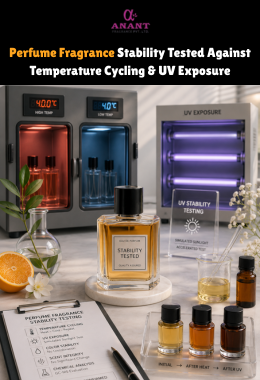
Labs run these tests inside sealed climate chambers that hold precise temperatures. A standard test for a perfume fragrance goes like this:
- The sample starts at normal room temperature, around 25 degrees Celsius
- The chamber heats up to 40 or 45 degrees and holds there for a set number of hours
- Then it drops to 4 to 8 degrees, simulating cold transport or storage
- That full hot-to-cold swing is one cycle -repeated multiple times over several weeks
- After each cycle, the perfume fragrance gets checked for colour change, cloudiness, smell shift, and chemical changes
The intensity of testing depends on the target market. A perfume fragrance going to Gulf markets faces far more aggressive heat testing than one meant for the UK. The test has to reflect the real conditions the product will actually face.
What UV Light Does to Perfume Fragrance
This one surprises most people. UV radiation does not just fade colours -it actively breaks apart fragrance molecules through a process called photodegradation.
UV light carries energy. When that energy hits certain aromatic compounds in a perfume fragrance, it breaks the chemical bonds holding those molecules together. A broken bond means a changed molecule. A changed molecule means a changed smell.
This is why two identical bottles of the same perfume fragrance can smell different after six months -if one sat on a sunny shelf and the other stayed in a dark drawer. The sunny bottle literally went through chemical changes. Natural ingredients like plant extracts and resins are hit hardest and also turn the liquid darker or brownish over time.
How UV Stability Testing Is Done
The perfume fragrance sample goes into a UV chamber that produces light close to natural sunlight intensity. A few weeks inside equals months or years of real-world exposure because the dose is accelerated.
After the test, the lab checks:
- How much the colour shifted compared to an untreated sample
- Whether the scent lost key notes or changed character
- What gas chromatography shows about which compounds degraded
The split-sample method is the standard approach. One sample goes into the UV chamber. An identical one stays in complete darkness. Comparing the two after the test shows exactly how much UV damaged that particular perfume fragrance formula suffered.
What Happens When a Formula Fails
If a perfume fragrance fails either test, it does not get launched. It goes back to the development team. Depending on what broke down, the team might:
- Replace unstable aromatic ingredients with more stable alternatives that smell similar
- Add UV filters or antioxidants to the formula to protect sensitive compounds
- Lower the concentration of ingredients that degrade too quickly
- Recommend switching to darker packaging -amber or cobalt glass that physically blocks UV light
That last point explains why so many quality perfumes come in dark bottles. It is not just aesthetics. Dark glass protects the perfume fragrance from light damage without touching the formula.
What This Means for Storing Your Perfume at Home
Knowing how stability testing works tells you something useful about storage too:
- Keep your perfume away from windows and direct sunlight
- Bathroom shelves near the shower are a bad spot -heat and steam both do damage
- A cool, dark drawer or a closed shelf works much better
- Dark glass bottles usually mean the brand has thought about UV protection
- If your perfume fragrance smells different after a few months, check where it has been stored before assuming it has gone off
FAQs
Q1. Can heat really change how a perfume fragrance smells?
Yes, quite noticeably. Heat breaks down fragrance compounds, and the scent can go from lovely to sharp or sour over time.
Q2. How long does a properly stored perfume fragrance last?
Three to five years in a cool, dark spot is very normal for most perfumes.
Q3. Why do so many perfumes come in dark bottles?
Dark glass blocks UV light and slows down the photodegradation of the perfume fragrance. Practical, not just pretty.
Q4. Is keeping perfume in the fridge a good idea?
Not bad at all, especially in hot climates. Cool and dark is exactly what a perfume fragrance needs to stay stable.
Q5. How do I know if my perfume fragrance has gone bad?
The smell shifts -sharper or more sour than before -and the liquid colour darkens. Both together usually mean the formula has degraded.
Follow us on Facebook and Instagram for more inspiration and product news.